
If you’ve ever typed “Am I behind financially?” into a search bar, you already know the feeling that comes with it. It’s not curiosity. It’s not ambition. It’s that quiet, sinking fear that maybe you missed something — that everyone else got the playbook and you didn’t, and you’re the only one still guessing.
But here’s the truth most money advice skips: this question is rarely about money alone. It’s about orientation — figuring out where you actually stand, whether past decisions permanently set you back, and whether your future is still flexible.
This article isn’t here to hype you up or drown you in rules. It’s here to give you clarity, context, and something real to work with — starting exactly where you are right now.
The One Question That Actually Tells You If You’re “Behind”
Most of us feel behind because we are comparing our ‘behind-the-scenes’ to everyone else’s highlight reel. We internalize these snapshots of success until they form an ‘Invisible Checklist’ — that nagging mental list of milestones society tells us we should have hit by now: a $100k salary by 25, a home by 30, a “fully funded” retirement by 40.
The standard timeline fails because it ignores the Invisible Weight you might be carrying—the specific hurdles that shift your starting line and dictate the actual pace of your race:
If you want to see how these hurdles play out across the country, ignore the “averages” you see in headlines. They are often skewed by the ultra-wealthy and don’t reflect the reality of most households.
If you feel like you’re the only one not hitting the “milestones,” use this Net Worth Percentile Calculator. You’ll likely find that the “average” is much lower than you’ve been led to believe.
Now that you’ve seen the ‘average’ is just a mathematical myth, the noise of comparison should start to fade. Instead of asking the society-driven question—’Am I behind for my age?’—you need to ask the only question that actually changes your future:”
| “Is my money situation moving forward, staying flat, or sliding backward?”
This shifts the focus from comparison (where you stand relative to others) to trajectory (where you are going relative to where you started). And the best way to find your answer isn’t through a complex formula; but by looking at the simple patterns in these three areas over the last 12 months.
Audit Your Financial Momentum in 60 Seconds
(Try it for yourself: Select the status that best fits your last 12 months in each category below to see your trajectory.)
The Momentum Meter
Check your financial trajectory over the last 12 months.
Understanding Your Result
Once you click those buttons, you’ll see one of two verdicts. Here’s what they actually mean for your life, not just your numbers.
If you see “Momentum” It means key parts of your money life are moving in the right direction. You’re not “done,” but you are moving — your job now is to protect that momentum and make it easier to sustain with simple systems, not harder with perfectionism.
If you see “Stabilization” It means you’re in a phase where the priority isn’t growth — it’s safety, clarity, and control. Nothing about this verdict means you’re “too late”; it just means your next moves should focus on reducing chaos, and building a small but steady base you can grow from.
“Behind” is a feeling,
not a fact.
The Three Seasons of Financial Growth
Most people judge themselves against the wrong phase. You might be in stabilization but comparing yourself to someone in compounding — and then calling that “failure.”
Stabilization
Phase 1- Learning how money works
- Getting income consistency
- Covering expenses no panic
- Building a small buffer
Net-worth growth here is slow or nonexistent. This is the essential work of the phase.
Traction
Phase 2- No more scrambling
- Decisions feel less urgent
- Savings stop disappearing
- Debt shrinking intentionally
From the outside, it doesn’t look impressive. From the inside, it feels calmer.
Compounding
Phase 3- Investments accelerating
- Career leverage paying off
- Options expanding
Compounding rewards what stabilization and traction quietly built.
Pick Your Next Move: (With Tools + Templates That Make It Easier)
Don’t overhaul your life.
This is where most people overcomplicate things: five apps, three days of tracking, then burnout. To move from anxiety to action, we start with a single, high-leverage tool that turns your ‘Invisible Weight’ into clear data points.
1) A ready-to-use expense tracker to see exactly where your money is going
As financial educator Nischa Shah often emphasizes, you must understand your cash flow first; everything else is just noise.
If you are in the Stabilization or Traction phase, this is the exact ‘clarity’ Nischa refers to. It turns your vague anxiety into a manageable data point. This ready-to-use tool helps you see exactly where your money is going without the burnout of manual spreadsheets.
👉 Expense Tracker by Nischa Shah. You can Access It Here→
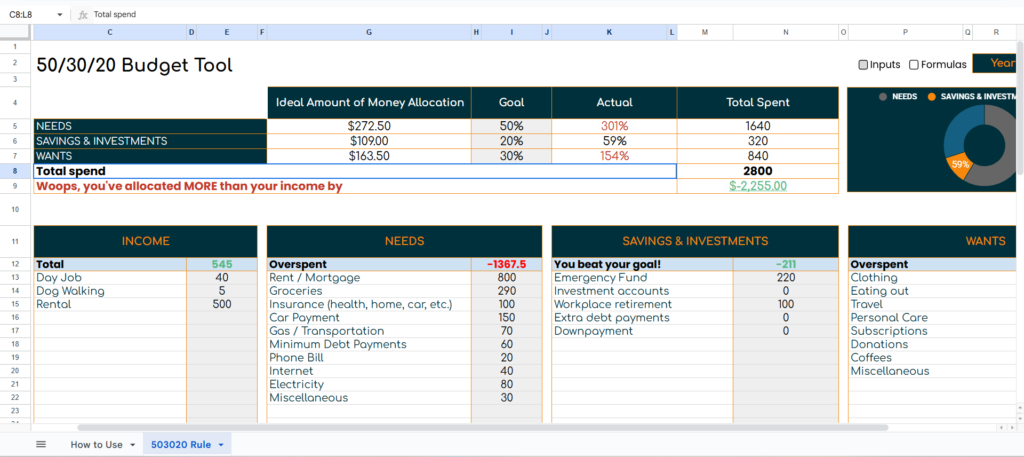
The 7-Day Observation Rule:
- Phase 1 (Days 1-7): Just track. Resist the urge to fix or judge your spending.
- Phase 2 (Day 8): Identify your “Leverage Point”—the one category creating the most stress.
- The Goal: Remember, tracking isn’t about control; it’s about removing the “not knowing” that keeps you feeling behind.
2) A physical saving system (Used by Thousands, for a Reason)
You’re looking for a fix. This is the fix.
If saving hasn’t been consistent for you, the problem usually isn’t discipline — it’s abstraction. Digital money doesn’t feel real, which is why it’s so easy to ignore, delay, or promise yourself you’ll “start next month.”
A physical savings challenge flips that. It forces visibility. Every deposit is something you can see, touch, and remember. Each step forward becomes tangible, and progress is no longer theoretical; it’s sitting right in front of you.
One simple way to do this is with an adult $10,000 savings challenge piggy bank you can keep somewhere visible in your home. You’re not trying to convince yourself to save anymore. You’re building a system where saving happens by default. It’s not about the amount; it’s about proving to yourself, over and over, that saving is actually happening.
👉 Check out the $10,000 Savings Challenge Box on Amazon →

If You Still Feel Behind After All This
If you still feel behind after all this, that just means your emotions haven’t caught up to your new information yet.
Feeling “behind” is usually made of three things: comparison to other people’s timelines, anxiety about what should have happened by now, and a harsh story about what your past choices mean about you. None of those are a reliable measure of your future. What actually matters over the next 10–20 years isn’t when you started, but that you’re now moving on purpose — with clearer awareness, calmer decisions, and systems that quietly keep you going.
If all you did after reading this was track your spending for 7 days or start the $10,000 challenge, you’ve already shifted from avoidance to action — and that’s the line most people never cross. Progress in money doesn’t look like a movie montage; it looks like small, repeatable moves that feel almost too simple while they quietly change your trajectory.
If this article helped you — or you know someone who quietly feels behind — share it with them, and feel free to leave a comment with what you’re doing next; your story might be exactly what someone else needs to see.